
The short answer
Here’s a truth that surprises a lot of people: you don’t get fitter during your workout — you get fitter afterward, while you rest. Exercise is the stimulus; the actual repair, growth, and adaptation happen during recovery. That means rest days aren’t slacking or a sign of weakness — they’re a non-negotiable part of the program. Push too hard without enough recovery and you don’t get fitter faster; you stall, break down, and risk injury. For most people, that means one to three rest days a week, plenty of sleep, and listening to your body when it asks for a break.
Why rest is when you actually get stronger
When you exercise — especially strength training — you create tiny microtears in your muscle fibres. That sounds bad, but it’s the whole point: those microtears signal your body to repair the muscle and rebuild it a little stronger and more resilient than before. Crucially, this repair-and-growth process doesn’t happen while you train — it happens afterward, during rest. Skip the recovery and your body never completes the rebuild, so you miss out on the gains you worked for and can actually go backwards.
It’s not just muscles, either. Rest gives your nervous system, joints, tendons, and connective tissue time to bounce back, and it lets your body restock its energy stores. Think of training and recovery as two halves of the same equation: the workout writes the cheque, and recovery is what cashes it.
More is not better
The instinct — especially when you’re motivated — is that if some exercise is good, more must be better, and rest days feel like lost progress. But that’s backwards. Training the same muscles again before they’ve recovered limits their growth and raises your injury risk. Constantly pushing without adequate rest leads to chronic fatigue, hormonal disruption, stalled progress, and burnout — a state called overtraining. The people who train relentlessly with no rest often make less progress than those who build in proper recovery. Rest isn’t the thing that slows you down; skipping it is.
How many rest days do you need?
There’s no single number — it depends on how hard and how often you train, your age, your sleep, your stress, and your experience. But sensible general guidelines apply to most people:
- At least one full rest day a week for almost everyone; two is better if you train hard.
- Beginners often do best with a full-body routine two to three days a week, which naturally builds in recovery.
- 48 to 72 hours between hard sessions for the same muscle group. If you train legs hard on Monday, don’t hammer them again Tuesday — work something else or rest. (This is why the beginner strength routine spaces sessions out.)
A useful habit: schedule rest days like you schedule workouts. Put them on the calendar and treat them as non-negotiable, rather than something you take only when you’re already exhausted.
Rest days aren’t couch days: active recovery
Important distinction: a rest day doesn’t mean doing nothing. Active recovery — light, low-intensity movement like a gentle walk, easy cycling, mobility work, or yoga — actually helps recovery by boosting circulation and easing soreness, without stressing your muscles. It also keeps you in the habit of daily movement, which is valuable in its own right. So a rest day is a great time for a relaxed walk or some gentle mobility work — just keep the intensity genuinely low.
The two most powerful recovery tools
Sleep is number one. This is where the real magic happens: during deep sleep, your body releases growth hormone, which drives muscle repair and tissue growth. Skimp on sleep and you undercut all your recovery, no matter how many rest days you take — aim for seven to nine hours, and see exercise and sleep for how the two reinforce each other.
Nutrition is a close second. Your body is actively rebuilding on rest days and needs fuel to do it, so don’t drastically cut calories, and make sure you’re getting enough protein spread through the day to supply the building blocks for repair — the target we cover in protein 101. Stay hydrated too. Recovery isn’t passive; it’s an active rebuilding process you support with sleep and food.
How to tell you’re under-recovered
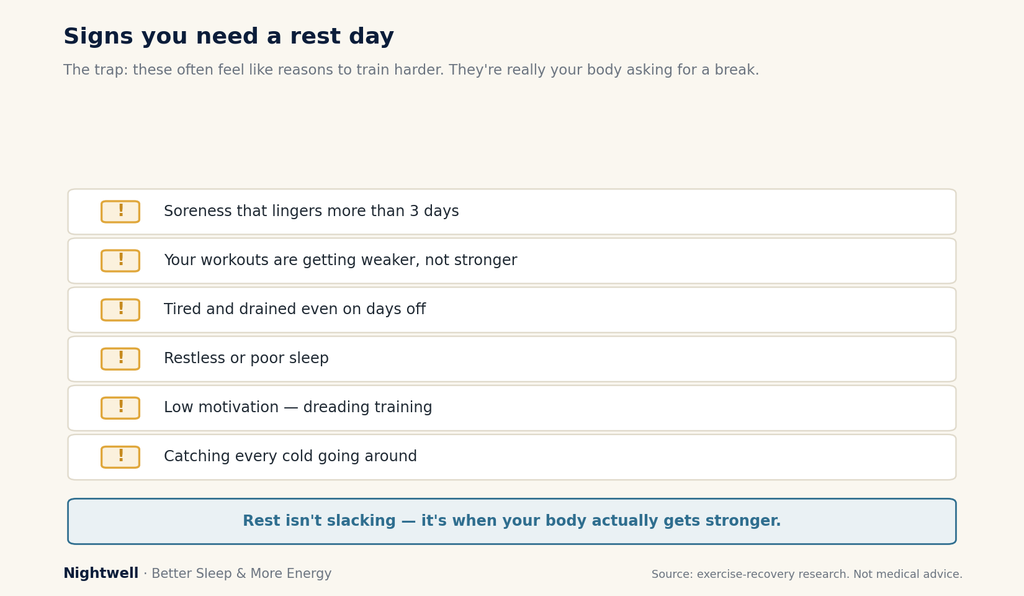
Your body sends clear signals when it needs more rest — the trick is not to misread them as “I need to push harder.” Watch for the warning signs in the graphic above:
- Soreness that won’t ease — normal next-day soreness fades within 24 to 48 hours; if you’re still sore after three days, you’re under-recovered.
- Declining performance — if your lifts are getting weaker or a familiar workout feels harder, your body hasn’t recovered.
- Persistent fatigue even on days off.
- Poor or restless sleep — overtraining can paradoxically wreck your sleep.
- Low mood or dread about training.
- Getting sick more often, as run-down bodies fight off infections less well.
If several of these show up, don’t power through — pull back, add rest days, and let your body reset. Serious, experienced trainers even build in a “deload” week every four to six weeks, cutting their training volume by a third or more, precisely to stay ahead of this.
Balance, not extremes
The goal isn’t to rest as little as possible or to rest constantly — it’s to match your recovery to your training. If you’re progressing steadily, sleeping well, and feeling good, your balance is right. If you’re stalling and dragging, you likely need more rest. And if you’re anxious that a rest day undoes your progress, remember the opposite is true: the rest day is what secures the progress. It also protects the long game — consistent, sustainable training beats short bursts of overtraining followed by injury or burnout, which is the whole point of building a habit that sticks.
The bottom line
Rest and recovery aren’t the opposite of progress — they’re how progress actually happens. Your muscles rebuild, your energy restores, and your body adapts during the downtime, not during the workout. So take at least one or two rest days a week, use active recovery to stay gently moving, protect your sleep and nutrition as your top recovery tools, and learn to read the signs that you need a break. Train hard, yes — but recover just as deliberately. That balance is what turns effort into lasting results, and keeps you healthy enough to keep going for the long haul.
This article is for general information and education and isn’t medical advice. If you have persistent fatigue, pain, or signs of overtraining, please talk to a qualified healthcare professional.
Sources: University of Washington — Recovery and Rest Days; Why Rest and Recovery Matter for Muscle Growth; Anytime Fitness — Why Rest Days Matter
Comments on “Rest Days and Recovery: Why More Isn’t Always Better”