
The short answer
We tend to admire willpower and self-discipline — but relying on them all day is exhausting, and it’s the wrong tool for building a better life. The smarter approach is habits. When a behaviour becomes a habit, your brain hands it off from the effortful “thinking” part to an automatic autopilot, so it happens with almost no mental energy at all. That’s why habits and routines are secretly one of the biggest energy-savers there is: every good choice you make automatic is one less decision draining your limited daily supply of willpower. Build the right habits and you free up your mind for what actually matters.
Why habits save mental energy
There’s real neuroscience here. When you first do something new — learning to drive, say — your prefrontal cortex runs the show. That’s the brain’s conscious control centre, responsible for decisions, planning, and self-discipline, and it takes intense effort and attention. But as you repeat the behaviour, your brain does something clever: it shifts the routine down to the basal ganglia, a deeper region that runs behaviours on autopilot, below conscious awareness. Scientists call this “chunking.” Once a behaviour lives there, it runs almost automatically — think of how an experienced driver navigates a familiar route while thinking about something else, or how you brush your teeth without rehearsing a single step.
The payoff is energy. Automating routine behaviours frees up your conscious mind and conserves mental bandwidth for complex, important thinking. Your brain isn’t being lazy when it does this — it’s being efficient, protecting a limited resource.
Willpower is a bad daily strategy
Here’s why leaning on willpower fails. Willpower is a prefrontal-cortex function — conscious and effortful — and it’s finite. It drains through the day and crumbles under stress and fatigue, which is exactly when you need it most. That’s the frustrating experience of being fully committed to a change in the morning and doing the opposite by evening: your automatic habit fires faster than your willpower can intervene. In a straight fight between willpower and an established habit, the habit usually wins.
This is liberating once you accept it. Instead of white-knuckling your way to good behaviour, you can build the behaviour into a habit so it no longer needs willpower at all. And there’s a bonus: every automatic good choice removes a decision, easing the decision fatigue we cover in why your to-do list exhausts you. You stop debating with yourself over whether to exercise, prep lunch, or start work — you just do it, because that’s what happens next.
The habit loop
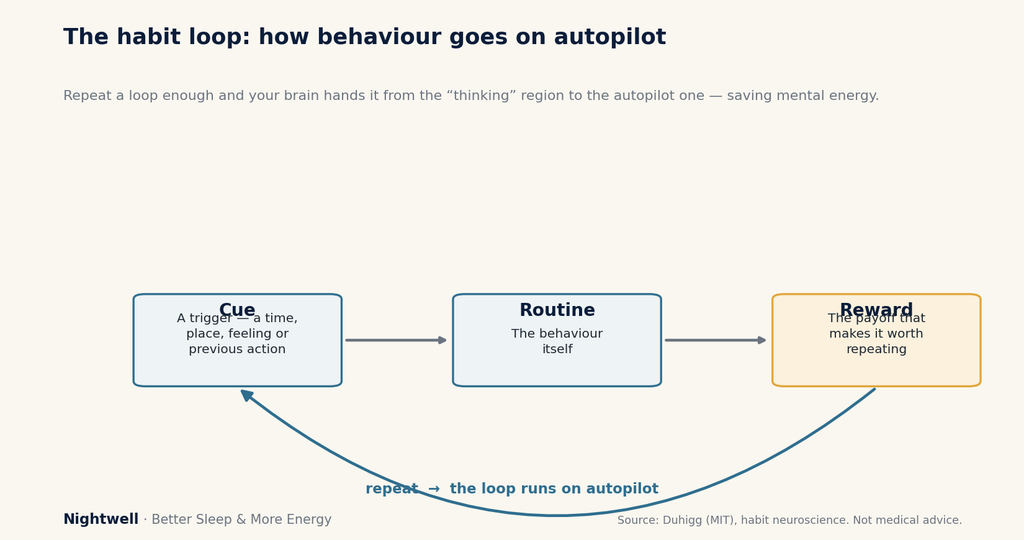
Every habit, good or bad, runs on the same three-part loop, first mapped by MIT researchers and popularised by Charles Duhigg:
- Cue: a trigger that kicks off the behaviour — a time of day, a place, an emotional state, or the action you just finished.
- Routine: the behaviour itself.
- Reward: the payoff that tells your brain the loop was worth repeating.
Repeat the loop enough times in the same context and your brain stops deliberating — the cue alone triggers the routine automatically. Understanding this structure is powerful because it shows you the levers: to build a habit, you engineer a clear cue and a satisfying reward around the routine you want. (One sobering note: your brain doesn’t distinguish good habits from bad ones — it strengthens whatever you repeat. Every mindless scroll reinforces a loop just as surely as every glass of water or evening walk. The mechanism is identical; only the behaviour you feed it differs.)
How to build a habit that sticks
Knowing the science, here’s how to actually make good behaviours automatic:
- Start tiny. The most common mistake is going too big. Shrink the habit until it’s almost embarrassingly easy — “do one push-up,” “read one page,” “write one sentence.” A two-minute version you’ll actually do beats an ambitious one you’ll abandon. Consistency builds the neural pathway; intensity doesn’t.
- Stack it onto an existing habit. Attach your new behaviour to something you already do automatically: “after I pour my morning coffee, I’ll take my vitamins.” The established habit becomes the reliable cue for the new one — the backbone of any good morning routine.
- Design your environment. Make good habits obvious and easy, and bad ones hard. Lay out your gym clothes the night before; keep fruit on the counter and biscuits out of sight; leave a book on your pillow. Willpower fails, but a well-arranged environment quietly does the work for you.
- Be specific. Vague intentions (“exercise more”) produce nothing; specific cues (“after work, I walk for 15 minutes”) become automatic far faster. Tie the behaviour to a concrete time and place.
- Make it satisfying. An immediate little reward — ticking it off, a moment of genuine pride — helps the loop lock in. Your brain repeats what feels rewarding.
- Give it time, and don’t stack too many at once. Habits take weeks of repetition to become automatic — often a couple of months — so expect an effortful early phase before it feels natural. And build one or two habits at a time; each new one competes for the same limited self-regulatory energy.
Routines: bundling habits together
A routine is simply a sequence of these behaviours strung together — and it’s where the energy savings really compound. A solid morning or evening routine means a whole chain of good choices happens on autopilot, with no decisions to agonise over. That’s why so many high performers keep their routines almost boringly consistent: it’s not rigidity for its own sake, it’s protecting their mental energy for the decisions that actually matter. A routine you don’t have to think about is a routine that never drains you.
The identity shift
The deepest version of this goes beyond behaviour to identity. When a habit becomes part of who you are — “I’m someone who moves every day,” “I’m a person who doesn’t skip breakfast” — it stops being a daily negotiation entirely. You don’t debate whether to do it any more than you debate brushing your teeth; you act because it’s simply who you are. That’s the point where a habit costs you almost nothing, and it’s the quietest, most durable form of self-improvement there is.
The bottom line
Willpower is a fragile, finite resource, and running your life on it is exhausting. Habits are the opposite: once formed, they run on autopilot, saving your mental energy and removing the constant drain of decisions. Use the habit loop to your advantage — set a clear cue, keep the routine tiny, reward yourself, and design an environment that makes the good choice the easy one. Build good behaviours into automatic routines, one at a time, and let repetition do the heavy lifting. Do that and the healthy choices that once took effort start happening on their own — freeing you up, and quietly powering the rest of the energy habits in how to get more energy naturally.
This article is for general information and education. Building habits takes time and repetition — be patient with yourself, and adjust the approach to fit your life.
Sources: The Neuroscience of Habit Formation (habit loop & basal ganglia); The Habit Loop — Duhigg & Clear explained; Habit Forming: How to Build Habits That Stick
Comments on “Habits and Routines: Why They Quietly Save Your Energy”